Toilet Partition Hardware Set: Why a Matched Kit Outlasts Mixed Parts
A toilet partition hardware set is not a bundle put together to make ordering easier. It is a set of parts that have to look identical in the same light, at the same height, within the same half-metre of the panel. Doors, legs, hooks and locks all end up side by side, so the eye judges them together whether or not the buyer specified them together.
We make hardware both ways — single fittings for repairs, and matched sets as the MG series — and after seventeen years of seeing what comes back, the pattern is consistent. Mixed parts fail on looks first and on maintenance second. Neither failure is about quality.
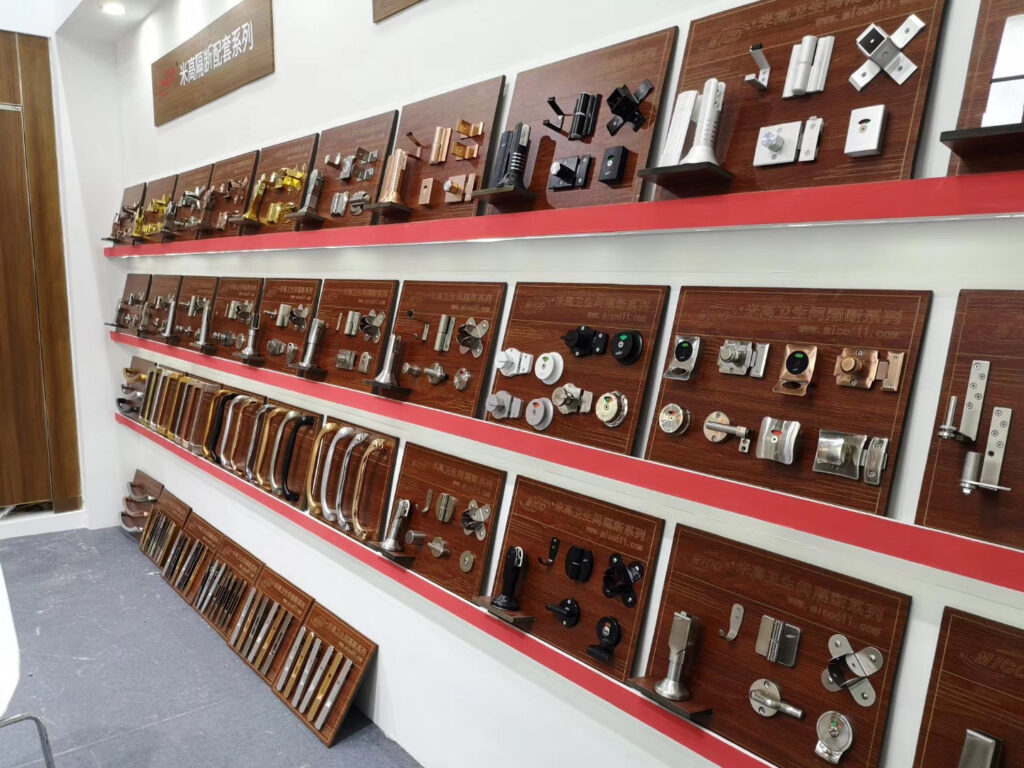
What a toilet partition hardware set contains
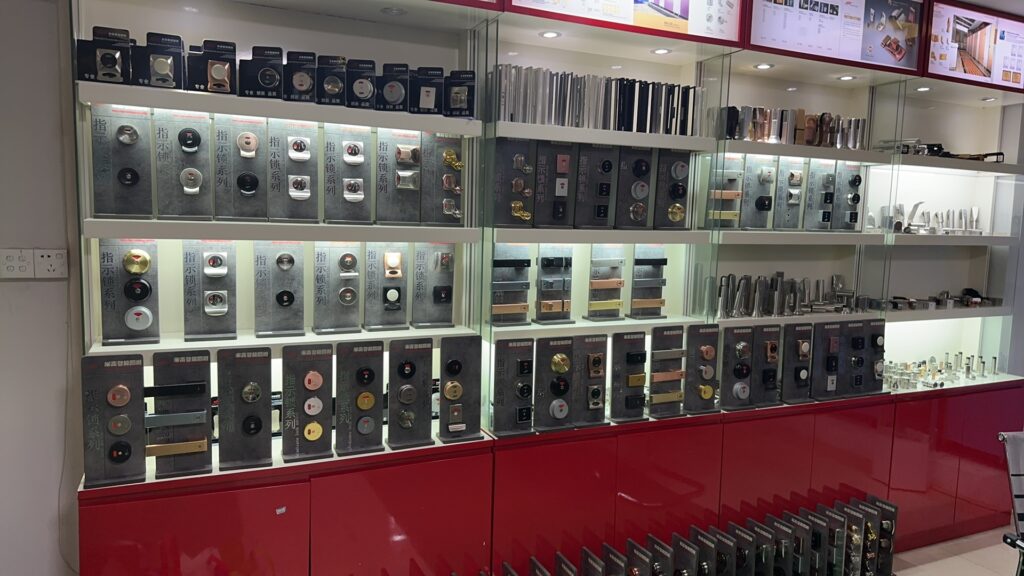
Every matched set in our range carries the same six component types, whatever the material or finish:
- Adjustable support pedestal — one per panel edge
- Self-closing hinge — two per door
- Indicator lock — one per door
- Pull handle — inside and outside
- Coat hook — one or two per cubicle
- Corner fastener or angle bracket — wherever the frame needs stiffening
Read a single series and you can see how the components are paired by size class. MG-06, for example, pairs a B7 leg (H136) with an A4 hinge (76×76), an E19 corner (33×45), an F2 hook (34×40), an F15 handle and a D6B indicator lock. MG-33, the zinc alloy set, uses a B33 leg, A33 spring hinge (80×62×12), E33 corner (50×40), F33 hook (30×36) and a 72×56 indicator lock. Nothing in either list is interchangeable with the other, which is precisely why a set ordered from one series stays visually consistent for its whole life.
The finish problem nobody prices in
“Matte black” is not a colour; it is a process. Two factories producing matte black hardware will produce two different blacks, and often two different blacks on different days, because the finish depends on pretreatment, coating thickness, cure temperature and the alloy underneath.
Within one batch the difference is invisible. Across batches — six months apart, from different suppliers, or from the same supplier’s second line — it shows up as a set of hooks that are slightly browner than the hinges, or legs that read grey next to a lock that reads blue-black. On a warm white wall, in daylight, that is the first thing a client notices, and it is unfixable short of replacing parts.
A matched set solves it by construction. One series means the legs, hinge plates, hook, handle and lock face were finished in the same run, from the same material, at the same time. It also means a mid-project top-up order can be matched — we keep the finish reference per series rather than per SKU.
This is why we publish eight finishes as standards rather than offering an infinite colour list: steel-wire brushed, matte black, titanium gold, red bronze, sand black, pearl chrome, dumb silver and luminous grey. A defined palette is what makes matching possible across an order, and across a re-order two years later.
Series by material and building type
| Series | Material / finish | Typical use |
|---|---|---|
| MG-04 / MG-05 / MG-06 | 304 stainless, steel-wire brushed | Schools, offices, clinics — the workhorse range |
| MG-07 / MG-08 | 304 stainless, steel-wire brushed | Larger cubicles, Ø66 indicator lock |
| MG-11 to MG-21 | 304 stainless, steel-wire brushed | Mid-size sets with gravity spring hinges |
| MG-33 | Zinc alloy, steel-wire or gold | Budget-led projects, dry environments |
| MG-35 | Stainless steel casting | Mixed panel systems, 55×79 lock body |
| MG-39 | Aluminium alloy, dumb silver | Design-led fit-outs, lighter panels |
| MG-55 to MG-68 | 304 stainless, steel-wire brushed (+ black / bronze editions) | Hotels, resorts, higher-spec commercial |
| MG-69 / 70 / 73 / 77 | 304 stainless, matte black or steel-wire | Contemporary schemes, black-on-wood-grain |
Counting a set for a purchase order
The most common ordering error is a set counted per cubicle when part of it is counted per door, or per panel. Get the base counts right and the rest follows:
- Per door: 2 hinges, 1 indicator lock, 1 inside pull, 1 outside pull
- Per vertical panel edge: 1 support pedestal
- Per cubicle: 1–2 coat hooks, 1 hanger bracket if the panel head needs one
- Per junction: 1 corner bracket, sometimes 2
For a 10-cubicle washroom with 11 partitions that typically lands near 20 hinges, 10 locks, 20 pulls, 22–24 legs, 10–20 hooks and 10–20 brackets. Somebody always counts the pulls per door and then buys 10 instead of 20.
The hidden cost of mixing suppliers
Buying parts separately looks cheaper on a spreadsheet and rarely is. Three costs do not appear on it:
- Site visits. Parts that do not fit together — a handle whose fixing centres miss the panel hole, a lock whose strike does not align — turn into a second visit. One visit costs more than the difference between a matched set and a mixed one.
- Spares inventory. One series means two or three part numbers in the maintenance cupboard. Four suppliers mean nine, and the one you need is always the one you did not stock.
- Finish drift. Already covered, but it is the one clients raise. A mismatch is a visible defect even when every part works perfectly.
What to check before you confirm a series
- Panel thickness and construction — the leg clamp and hinge plate both depend on it
- Door handing count, per washroom
- Finish against an actual panel sample, not a screen
- Environment: coastal, chlorinated, aggressive cleaning regime
- Whether every component you need sits in the same series (some series have no coat hook)
- Spares: one extra lock per handing, extra buffers
Frequently asked
Can I buy just the lock from a set?
Yes. Single fittings are available separately — MOQ is 500 pieces for single fittings against 100 sets for a full series. The limitation is colour matching to hardware bought years ago; send us a photo in daylight and we will tell you honestly whether the current finish will match. How those two minimums differ is explained in what 100 sets actually means.
Why not mix stainless legs with zinc alloy hinges?
You can, and it is common on repairs rather than new builds. The risk is finish, not function: the two alloys take the same nominal finish differently, so they will read slightly different in the same light, and they will age at different rates.
Is a matched set more expensive than buying parts individually?
Usually not on the total, because the set is quoted as a series rather than as six line items, and it removes the mismatch risk. Ask for both prices on the same specification before deciding — that comparison is fair and we would rather you made it with real numbers.
Do you supply the set for panels we bought elsewhere?
Yes, and it is most of what we do. Send the panel thickness, material and a photo of the panel edge, and we will confirm which clamp and hinge plate fit.
Next step
Send a cubicle count, the panel specification and the finish you have in mind. We will come back with a series recommendation, a component count you can check against your own and a quotation in 2–3 working days. Standard samples ship in 7–10 days; customised samples need mold development, typically 15–25 days — the levels of branding and tooling involved are set out in OEM cubicle hardware explained.
See the matched sets | Request a set quotation | Stainless vs zinc alloy